Varnish, or Oil?
There are two basic finishing approaches for wood that stays outdoors. Many brands use varnish on their products because first-day gloss is high and it is visually impressive straight from the factory. As a maker we prefer Italian Teak oil — in this guide we explain the technical reasons and the long-term comparison.
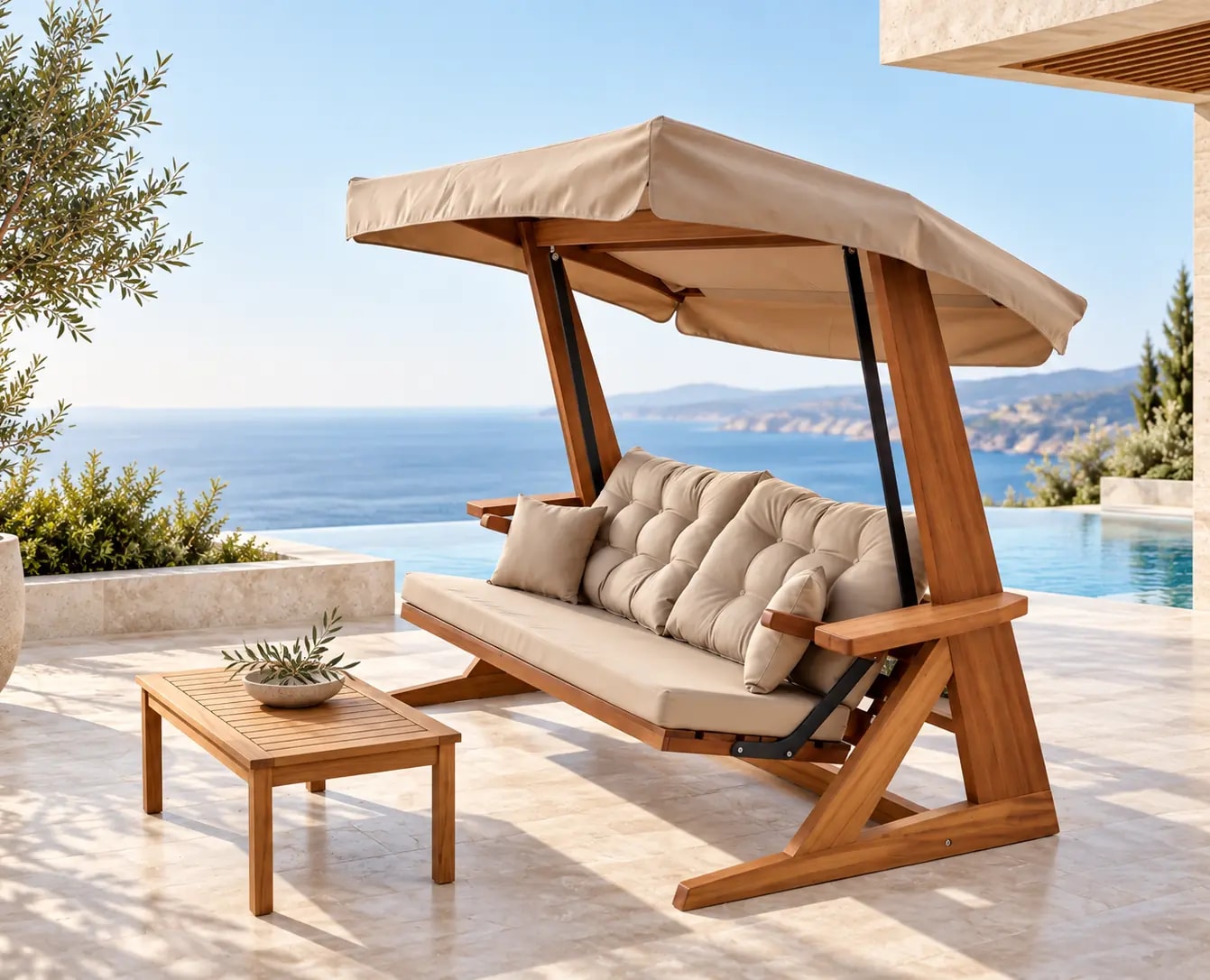
Varnish is a surface film, oil works into the wood. This basic difference determines everything in the long run: varnish blisters in 2-4 years, leaks water into the wood and requires a full restoration; oil works for 15+ years with an annual refresh. For wood that stays outdoors continuously, like a garden swing, the right choice is oil — especially the standard of a tung + linseed oil based Italian Teak oil. Varnish may be reasonable for an enclosed space (an indoor table); for outdoors it means short-term looks + a long-term problem.
1. Varnish: Surface Film Theory
Varnish is not actually bonded to the wood; it is a transparent plastic film sitting on top of the wood. Typical outdoor varnishes are acrylic, alkyd or polyurethane resin. On first application it forms a glossy, hard, waterproof layer — a very impressive look straight from the factory.
The problem starts over time. Three physical events fatigue the varnish film:
- UV degradation: Solar radiation breaks down the resin; the film becomes brittle, yellows, then cracks.
- Thermal expansion difference: Wood and varnish expand and contract at different rates. With the change of season the film develops micro-cracks.
- Moisture trapping: Once a crack forms, water gets under the film but cannot get out — the wood begins to rot; the film looks intact on the surface but the deterioration underneath is silent.
As a result, in Turkey's climate the outdoor varnish life is on average 2-4 years. After that the film must be stripped and the whole surface sanded from scratch + re-varnished. This restoration is a professional painter's job, hard to do in home conditions.
2. Oil: Penetration Theory
Oil is the opposite approach. It leaves no film on the surface; it works in between the wood fibres and dries and polymerises inside. Good formulas use a linseed oil + tung oil mix: linseed oil provides deep penetration, tung oil contributes UV resistance and hardening.
This approach has three important advantages:
- The wood breathes: Seasonal moisture balancing is not prevented; the wood expands and contracts but is protected from within.
- Cumulative protection: At the annual refresh new oil is added on top of the previous coat; the old one need not be stripped. With each application the depth increases.
- Local repair is easy: If staining occurs at one point, oil is refreshed at that point; there is no need to renew the whole surface.
Visually, oiled wood has a matte or light satin tone; it brings out the wood's natural texture. It is not as glossy as varnish but the “wood shows” — this aligns with most customers' preference.
The difference in one table
| Property | Varnish | Oil (Italian Teak) |
|---|---|---|
| Surface behaviour | Leaves a hard film, sits on top of the wood | Penetrates the wood, no film |
| Does the wood breathe | No — traps moisture | Yes — moisture is balanced |
| UV behaviour | Blisters in 2-3 years, flakes off | Stays stable with an annual refresh |
| Thermal cycle | Blisters on expansion, water gets under it on cracking | Works together with the wood |
| Refresh method | Strip the old layer by sanding + re-varnish | Apply a new coat on top, no stripping |
| Refresh time | Full restoration 2-3 days | 2-3 hours work + 24 hours drying |
| Refresh frequency | Full restoration every 2-4 years | A thin coat 1-2 times a year |
| Appearance | Glossy or satin, plastic-textured | Matte or satin, wood-textured |
| Water behaviour (drop test) | Water rolls off, not absorbed | Water absorbed within 30-60 sec |
| Long-term life | 5-8 year full renewal cycle | 15+ years of maintained use |
| Repairability | Local repair difficult, usually the whole surface | Local oil refresh possible |
Why Deniz Salıncak uses oil
As a maker, using varnish would have given us two short-term advantages: factory-exit gloss + a first-day “brand-new product” feel. These two advantages would have worked well at sale.
But for a product that will stay outdoors for 5-15 years, a short-term finish is a long-term customer loss. A varnished swing flakes off like a peel in front of the customer after 3 years, and unless we are talking, the customer moves to a rival brand. An oiled swing is still like new after 3 years, and the customer returns to us later.
Italian Teak oil — tung + linseed oil based, UV stabilised, silicone-free formula — is the standard we have used since 2000. Its only side effect: it needs 2 hours of maintenance a year. In return for this investment the product life more than doubles.
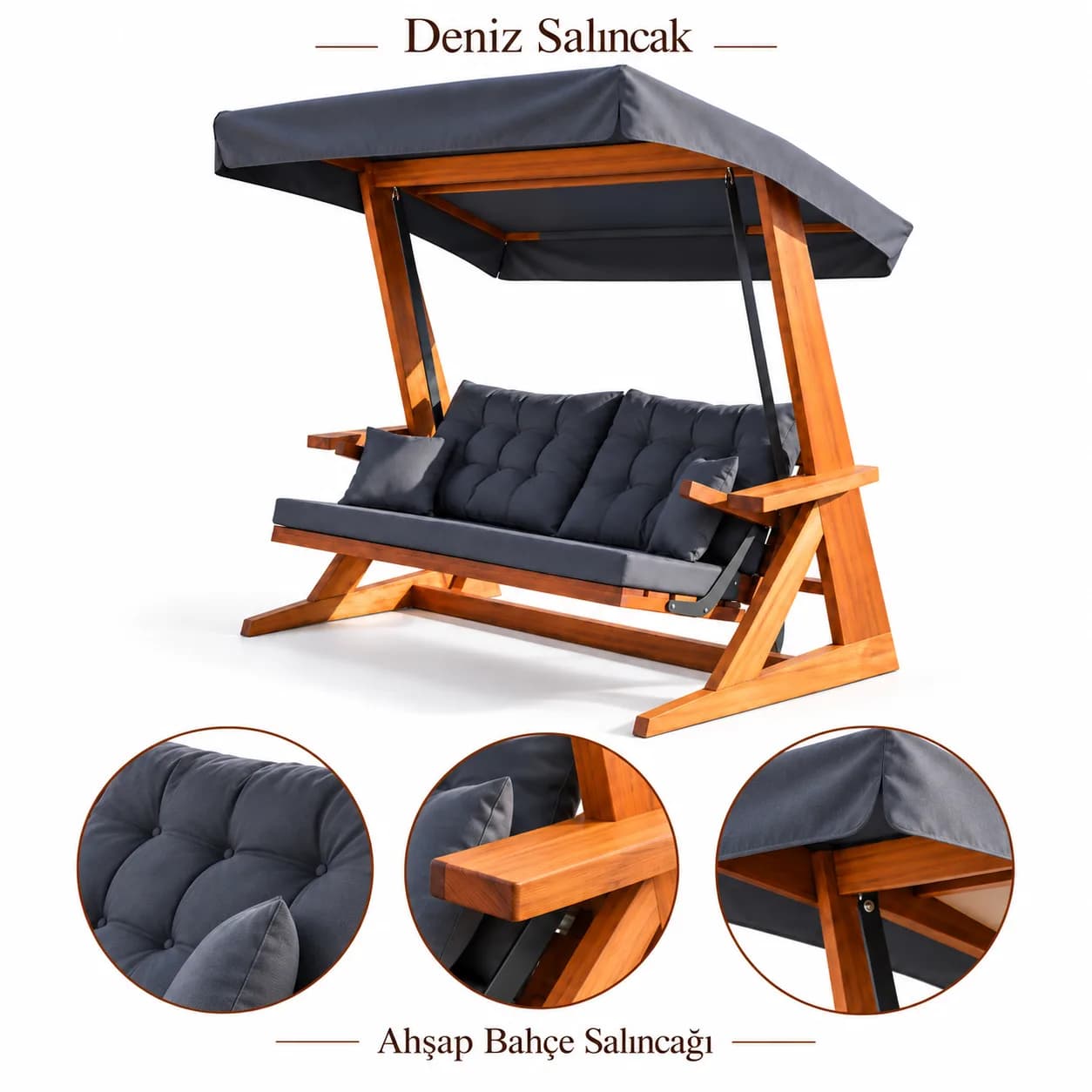
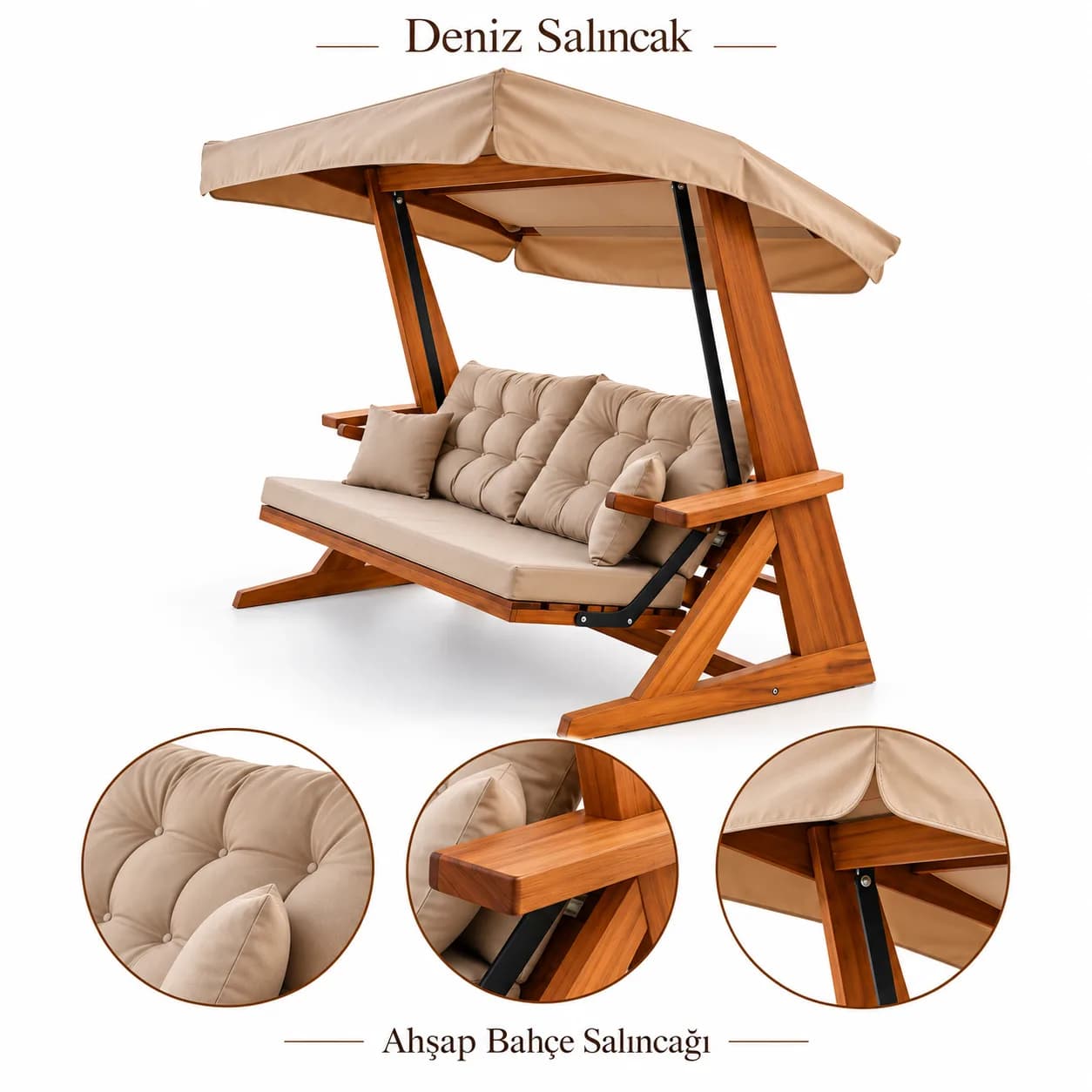
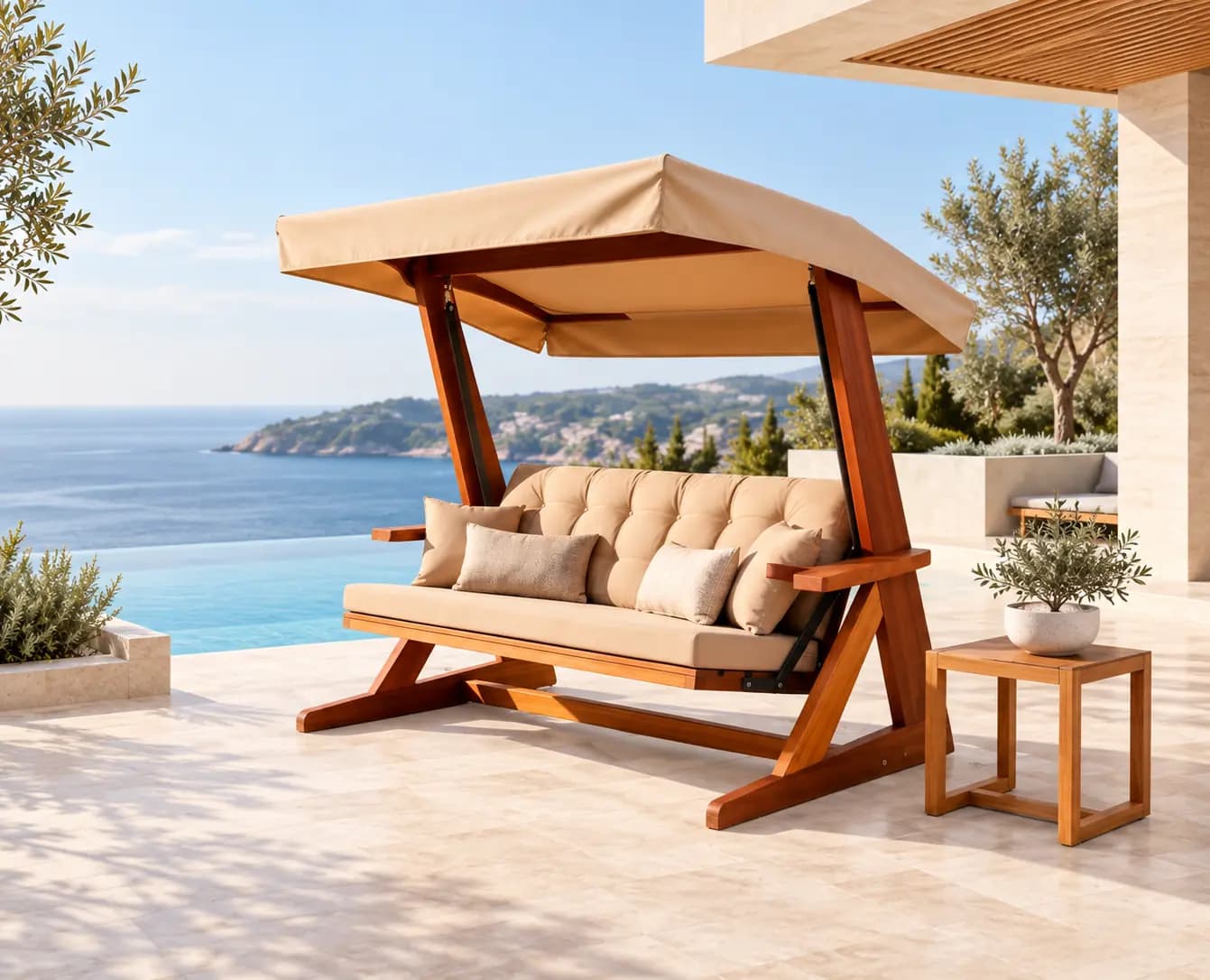
Solid Iroko, in the garden and in the studio.
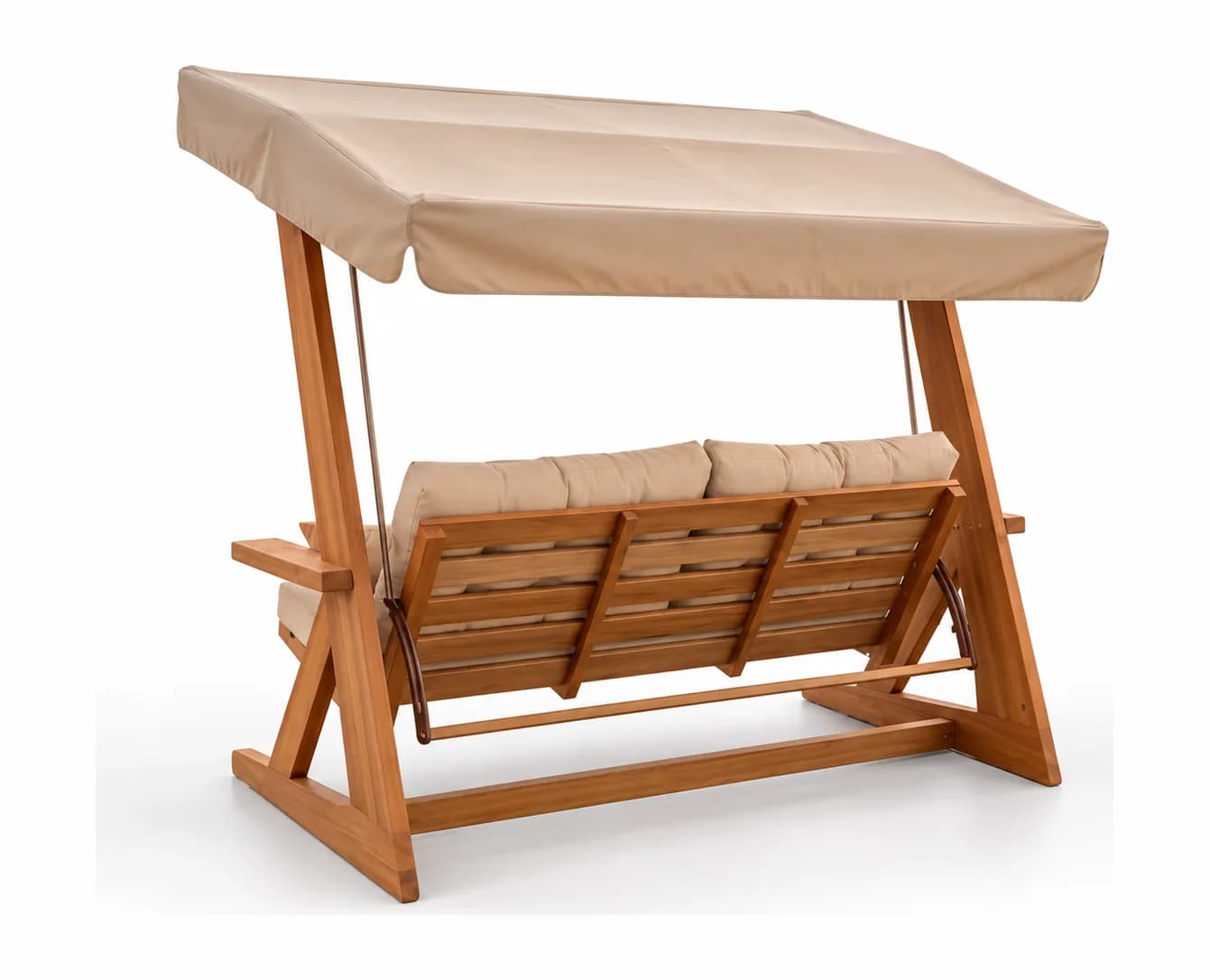
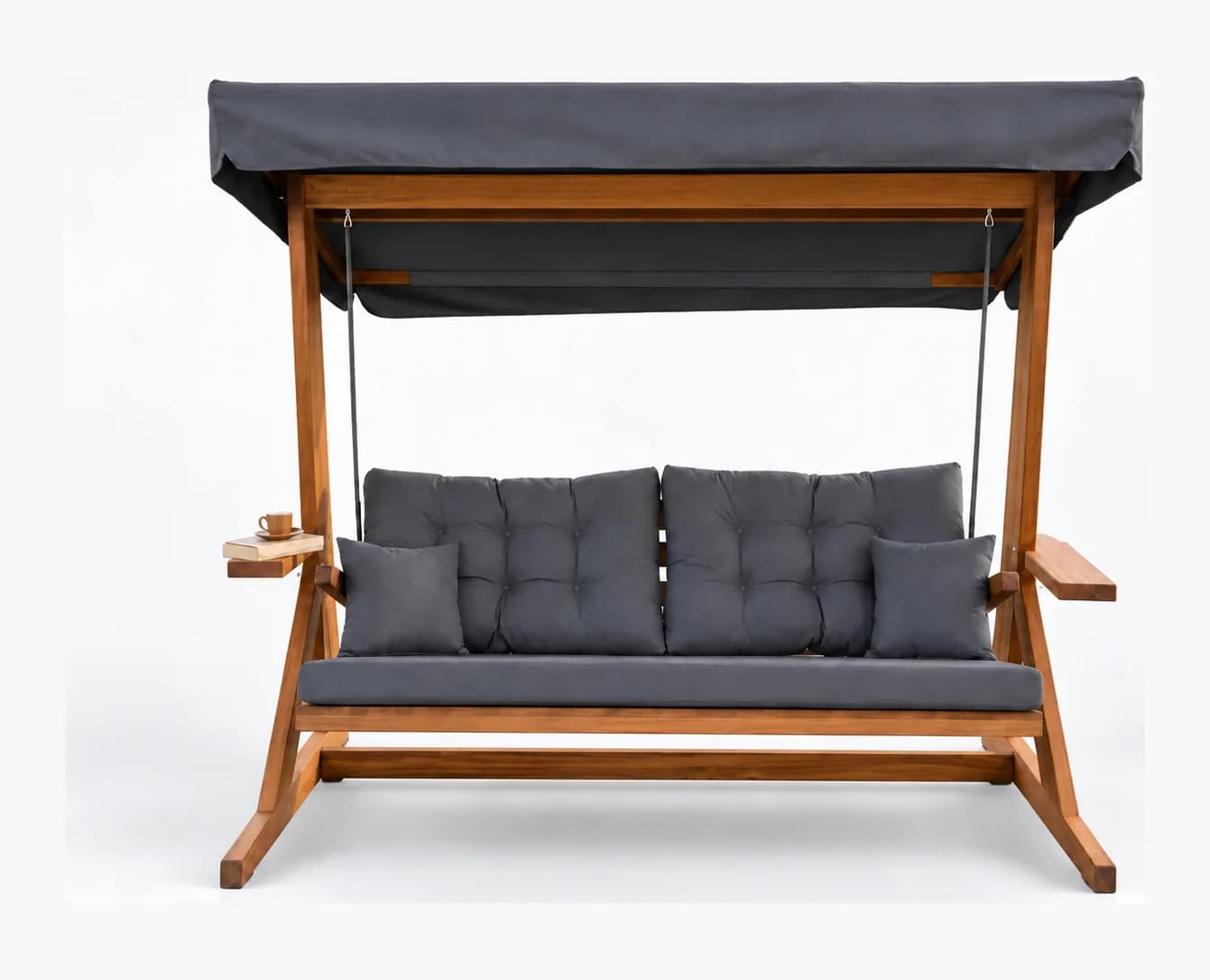
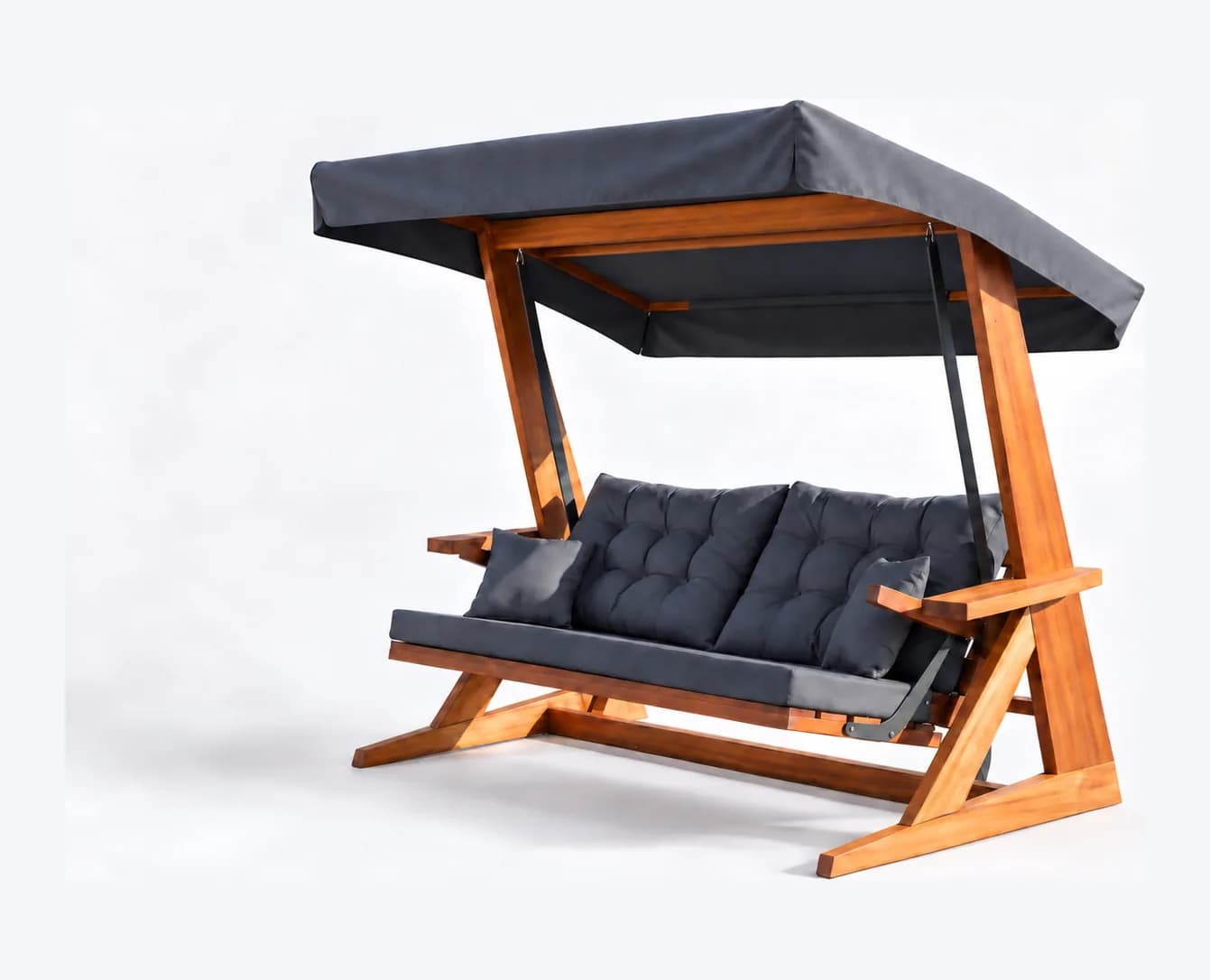
Mihenk 2400 — a selection of garden and studio frames with mustard and anthracite cushions; the product page has every frame and the colour selector.
Frequently asked questions
Is varnish or oil better for outdoor wood?
For wood that stays outdoors continuously — such as a garden swing, table, chair — oil is preferred. Varnish leaves a hard film on the wood; after 2-3 years this film flakes off like a peel under UV and thermal cycling, holds water underneath and rots the wood. Oil penetrates the wood, the wood breathes, and UV protection and moisture balance are provided from within. A refresh 1-2 times a year is enough, with no stripping at all.
How do I tell a varnish-coated swing?
A varnished wood surface is glossy and plastic-textured; when you touch it with a bare hand the wood pattern is not felt, it is like a glass surface. Oiled wood is matte or lightly satin, and when touched the wood fibres are noticeable to the finger. Drop test: drip water on the surface — on varnish the water rolls off and the wood absorbs nothing; on an oiled surface the water is absorbed within 30-60 seconds.
What is Italian Teak oil, how does it differ from normal oil?
Italian Teak oil is typically a mix of linseed oil + tung oil + UV stabiliser + fungus inhibitor. In high-quality formulas there is no silicone (silicone makes the renewal application difficult). The cheap alternatives sold as ordinary “wood oil” are usually paraffin or mineral-oil based — these stay on the surface, do not penetrate, and evaporate quickly. Prefer professional products whose label states tung + linseed oil based.
Can I convert an oiled swing to varnish myself?
Not recommended. Varnish does not adhere to an oiled surface — the film does not hold and lifts. If conversion is needed, removing the oil residue completely requires heavy sanding (60-80 grit) + solvent cleaning, and this process takes 1-2 mm off the wood thickness; in the long run it shortens the product life. The reverse is also true: oil does not penetrate a varnished surface, and you cannot switch to oil without stripping the varnish.
How many times a year is an oil finish applied?
One application a year is enough: a single thin coat at the spring opening (March-April). On sites with intense sun (Mediterranean and Aegean coasts), or if the surface dulled over the summer, a second light coat in autumn preserves the colour. Each application takes 2-3 hours of work + 24 hours of drying; total annual maintenance is 2-3 hours, 4-6 with a second coat.
Does varnish peel off in 5 years, is that real?
The average film life of a standard polyurethane outdoor varnish in Turkey's climate is 2-4 years. With premium 2K (two-component) industrial varnishes this can extend to 5-8 years, but these varnishes cannot be reapplied in home conditions and require an authorised painter. With an oil application the surface is never “stripped” — a new one is simply added on top. In the total-life calculation this difference is decisive.
Oil chosen. A 15-year investment.
Solid Iroko + Italian Teak oil standard. Protection that works into the wood instead of varnish. 15+ years with 2 hours of maintenance a year. 2-year warranty, free shipping to all 81 provinces.
Iroko swing finished with Italian Teak oil